
A field guide for Trade Partners who win the next job because they handled the last invite right.
A bid invite arrives. You have a window. The rest of the week, you have crews to run, change orders to chase, and three other invites in your inbox. Most small subs respond to bids the way they respond to email — when there's time. There's never time.
The wins go to the shop with a process. Not a bigger estimating team. Not better prices. A process.
Here's the one we'd run.
01 · Triage in 24 hours, not 24 days
Before you price anything, decide if you're bidding. Most invites should be a polite "no." A "no" sent on day one is a relationship. A "no" sent on day twenty is a strike against you.
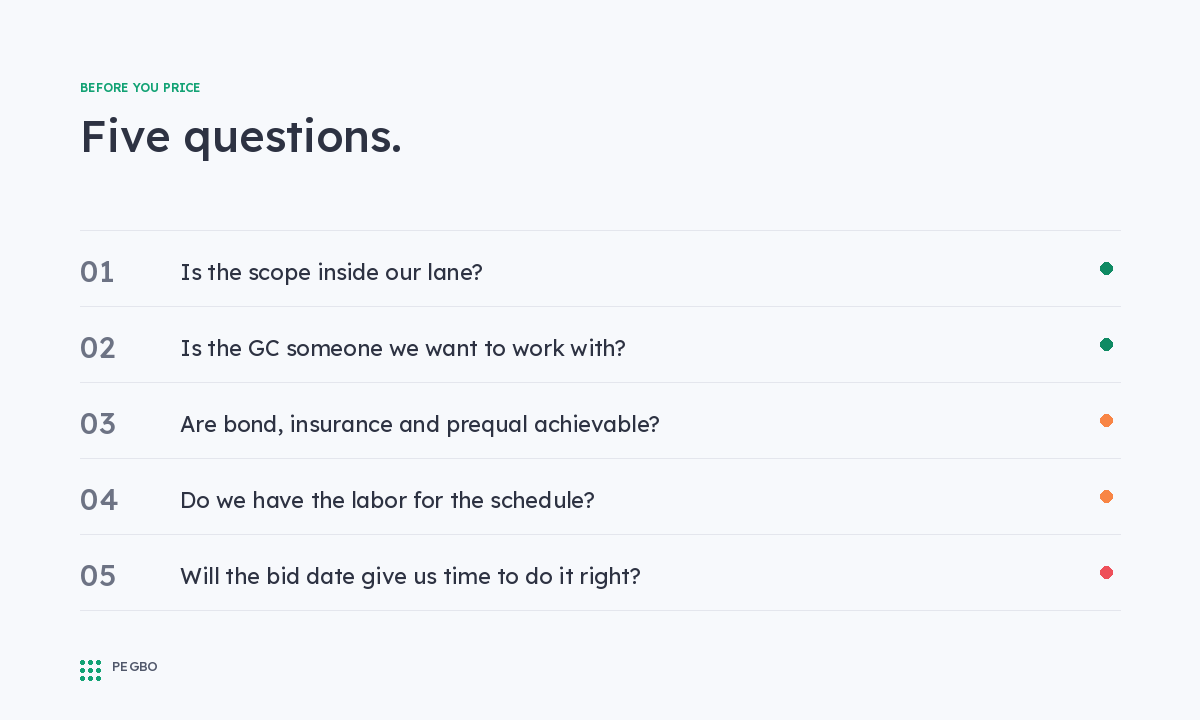
Run every invite through five questions on the day it lands:
- Is the scope inside our lane? If you self-perform 80% of a CMU package and they're asking for cast-stone facade work, that's a sub-sub. Decline.
- Is the GC someone we want to work with? Check past payment history. Two phone calls. Sixty seconds each.
- Is the bond, insurance, and prequal achievable? $5M bonded with 60-day terms is a stretch for some shops. Know before you price.
- Do we have the labor for the schedule window? A great number on a job you can't man is the worst outcome.
- Will the bid date give us time to do it right? Anything under seven days for a $500K+ package usually means a half-built number.
Three "yes" answers and a defensible "yes" on the other two — bid. Otherwise, decline today. The GC will remember who replied on day one, and remember harder who went silent for three weeks.
Decision quality on day one beats price quality on day twenty.
02 · Documents: Read the docs like a contractor, not a salesperson
Once you're in, read the package twice. First pass: skim everything to find what isn't there. Second pass: price.
What you're hunting on pass one:
- Inclusions and exclusions in the spec, not just the ITB. The invitation letter says one thing. Spec section 03 30 00 says another. The spec wins, every time.
- The schedule. Phasing changes price more than material cost ever will.
- The pay terms. Net 45 with retainage held to substantial completion is a different job than net 30 with retainage released at 50%.
- The bid form. If the GC wants unit pricing for excavation depth bands, your lump sum is wrong before you start.
If anything is missing, ask in writing. Today. RFIs sent two days before the bid date make you look like a tourist. RFIs sent on day two make you look like a partner.
03 · Walk the site. Even if you've been there.
Go to the pre-bid walk. Two reasons: existing conditions change, and the people on the walk are the people you'll be working with on the job.
Bring: a tape, a flashlight, a notebook, your phone for photos, and three questions you couldn't answer from the docs alone.
Leave at the office: opinions.
What to ask in front of the GC and the other subs: nothing strategic. Save the real questions for a written RFI after. The walk is for verifying conditions, not negotiating in public.
04 · Pricing: Build the number in four parts
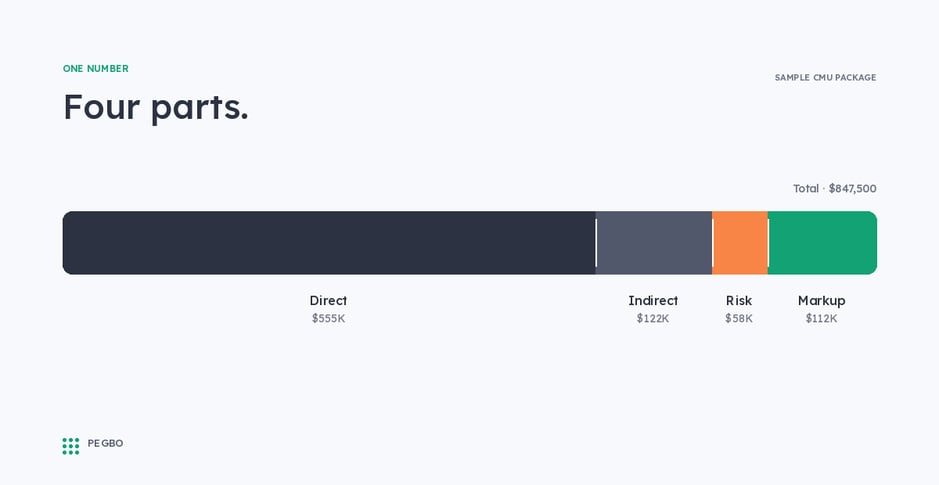
Don't price a bid like an invoice. Price it like an argument you'd defend in a value-engineering meeting.
Direct cost — labor, material, equipment. Use your actual production rates from the last three jobs of this type, not the industry book.
Indirect cost — supervision, layout, cleanup, mobilization, small tools, consumables. Most small subs lose money here, not directly.
Risk — coordination with adjacent trades, weather window, schedule compression, and owner-furnished material. Put a dollar number on each risk. Sum it. That's your contingency. Don't bury it inside other line items; show it as its own number.
Markup — overhead and profit, on separate lines. If the GC asks you to drop your number after the award, you want to know which line you're dropping.
A bid built this way survives a buy-out meeting. A bid built as one big lump-sum doesn't.
05 · Cover Letter: The cover letter that wins
One page. Three paragraphs. That's the whole letter.
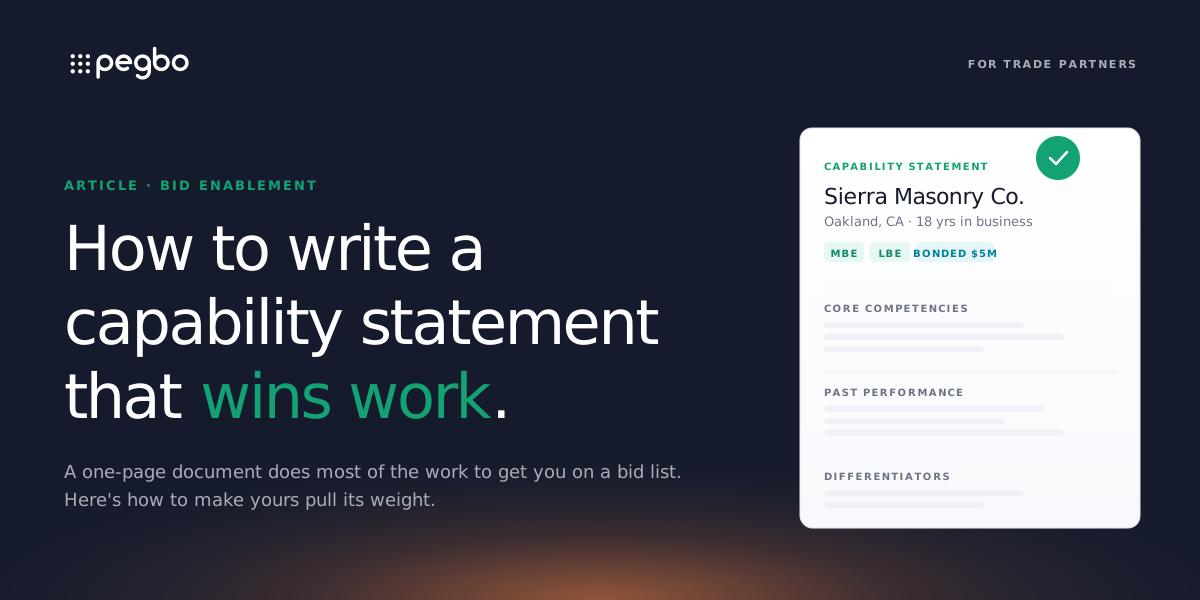
Sierra Masonry is pleased to submit our proposal for the [Project Name] CMU and brick veneer scope, dated [Date]. Our number is $847,500, valid for 30 days.
We've included all work shown in spec sections 04 20 00 and 04 21 13, plus the embed plates called out on S-301. We've excluded sealants at dissimilar materials, structural steel lintels, and after-hours work. Allowances and unit prices are on page 3.
We've self-performed 14 CMU packages between $400K and $1.2M in the last 18 months. References on page 4. We can start within two weeks of award, and our PM, [Name], will be your single point of contact through closeout.
No logos are taking up half the page. No mission statement. The GC's estimator is reading 22 of these tonight. Be the one they don't have to decode.
06 · Checklist: The 10-point pre-send checklist
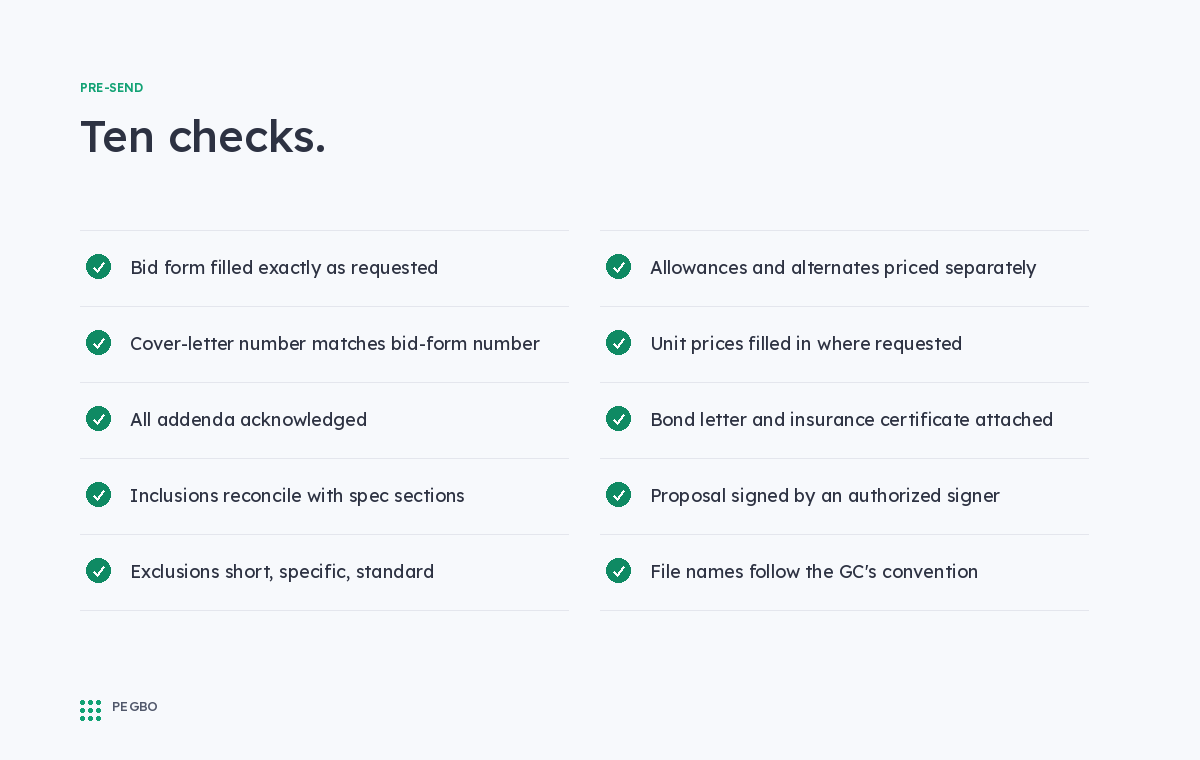
Before the bid leaves, walk through this list. Out loud. With one other person in the room.
- Bid form filled out exactly as requested — no substitutions on the form itself.
- The number on the cover letter matches the number on the bid form.
- All addenda acknowledged by number and date.
- The inclusions list reconciles with the spec sections referenced.
- Exclusions list is short, specific, and standard — not a wall of CYA.
- Allowances and alternates are priced separately.
- Unit prices filled in everywhere they're requested.
- Bond letter attached if required. Insurance certificate current.
- Proposal signed by someone authorized to bind the company.
- File names follow whatever convention the GC asked for.
Miss number 10 and a great bid land in the wrong folder. Miss number 3, and you've handed the GC an excuse to throw out your number on a technicality.
07 · Follow-up: After you send
Send a one-line confirmation email the moment the bid leaves: "Bid submitted at 1:47 PM PST — confirming receipt on your end?" Get a human reply. Save it.
Then wait. Don't call to "check in." Call only if there's a clarification you'd add — that's a reason. Seven business days past bid date with no word, send a polite note asking for the timeline for the award. Stop there.
If you don't win, ask why in one short email: "Was our number high, our exclusions wide, or our schedule tight?" Most GCs will tell you. That intel is worth more than the next bid.
Where a system helps
The shops that win consistently don't have a better estimator. They have a better workflow. Every invite is triaged the same day. Every spec is read by two people. Every bid leaves with the same checklist run on it. Every GC gets the same follow-up cadence.
Process beats heroics. The shop with a process is the shop that books the next job.
That's what Pegbo is for on the GC side — coordinating coverage so the right Trade Partners get invited in the first place. On the sub side, the lesson is the same.
Bid like it.
1M+ verified Trade Partners. One platform.
Your team focuses on relationships. Pegbo handles coordination — bid coverage, outreach, qualification, and scoring.
Book a Demo