
Most capability statements read like business cards in long form. They list what a company does, who runs it, and where to find them — and that's where the document stops. The capability statements that actually win work do something different. They tell an estimator or procurement officer, in under 30 seconds, exactly why a Trade Partner belongs on a specific bid. They prove fit before anyone asks for it.
This guide walks through the structure, the language, and the mistakes that quietly kill an otherwise qualified bid.
What a capability statement is actually for.
A capability statement is a sales tool, not a brochure. Its job is narrow: get you onto the next bid list, RFP shortlist, or vendor file. Every choice — what you put in, what you cut, where it sits on the page — should be made against that one goal.
Estimators don't read these documents. They scan. A typical procurement workflow goes like this: open the PDF, find the scope match in 5 seconds, find the bonding number in 10, find a recent similar project in 20. If any of those don't surface fast, the document closes and the next one opens.
That's the moment your statement either lands you on the invite list or doesn't. The estimator is filtering Trade Partners by scope, location, certifications, and bonding capacity in the same breath. Make those four facts impossible to miss.
The five blocks every winning statement contains.
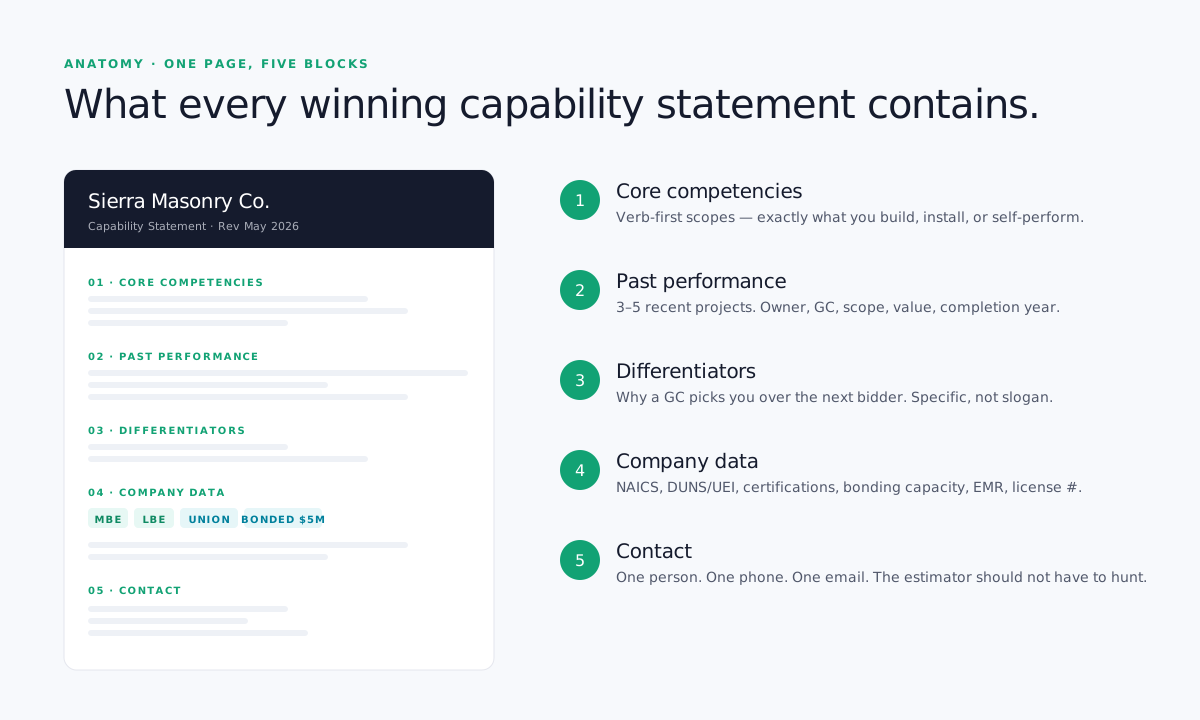
Almost every strong capability statement we see in the field maps to the same five blocks, in roughly this order. Skip one and you give the estimator a reason to move on.
Core competencies — what you actually do.Verb-first scopes. "Self-perform CMU and structural masonry up to 6 stories" beats "leading provider of premier masonry solutions." The first tells an estimator whether you fit. The second tells them nothing.
Past performance — proof you've done it.Three to five recent projects, each with: project name, owner, GC, scope value, and completion year. Two years old is fresh. Five years old is a yellow flag. Ten years old should be cut.
Differentiators — why you over the next bidder.Specific, not slogan. "Self-performed crew of 22, no manpower lent out" is a differentiator. "Quality and integrity" is wallpaper. If a competitor could put the same line on their own page, cut it.
Company data — the filter fields.NAICS code(s). UEI/DUNS. State license number. Bonding capacity (single + aggregate). EMR if it's under 1.0. Certifications as scannable chips: MBE WBE UNION BONDED $5M. This is what GC procurement systems filter on.
Contact — one person, one phone, one email.Not "info@" and not the front desk. The named human who picks up when an estimator calls at 4:30pm on a Friday with a scope question. Make it easy to reach the right person on the first try.
Write for the estimator, not the marketing team.
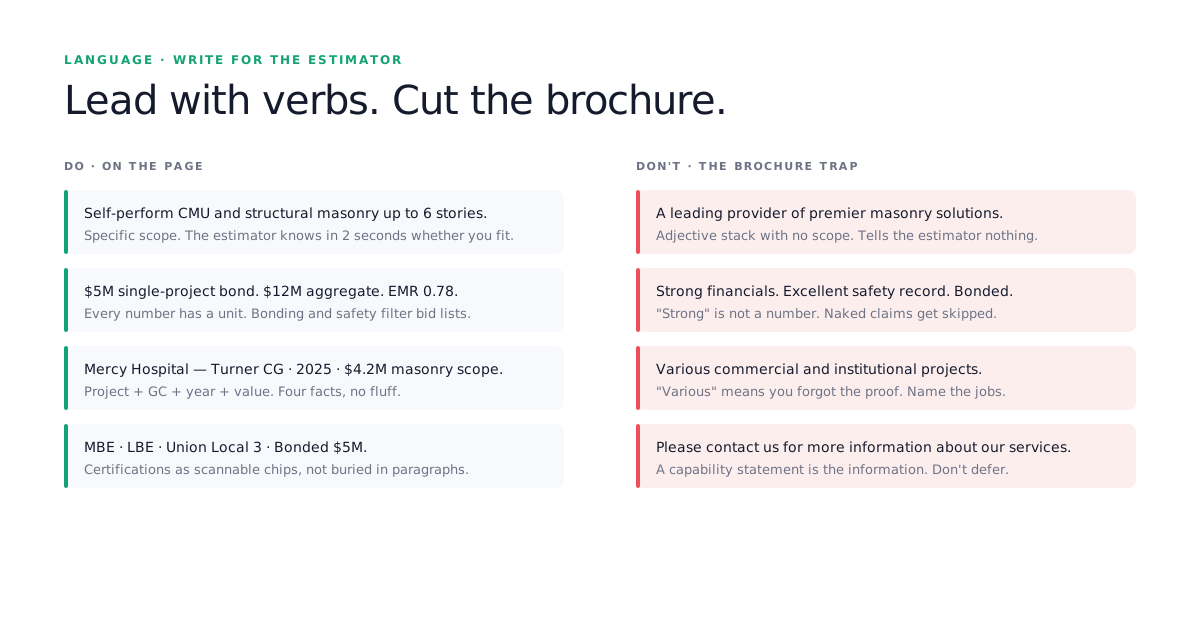
The single biggest upgrade to most capability statements is replacing adjective-driven language with verb-driven, number-driven specificity. Estimators are reading dozens of these. They want facts they can drop straight into a bid list spreadsheet.
Two rules carry most of the work. Lead with verbs: "Install," "Self-perform," "Fabricate," "Coordinate," "Bond to." Every number gets a unit: "$5M bonded," "EMR 0.78," "18 yrs in business," "22-person crew." Naked numbers and naked claims both get skipped.
Common mistakes that quietly kill the document.
The wall of text.
Three dense paragraphs about company history. An estimator will not read them. Cut to a single line: "Family-owned, founded 2008, headquartered in Oakland, CA." Move on.
Generic capabilities.
"Commercial construction services" is not a capability. "Tilt-up panel erection up to 75 ft" is. Specificity is what separates Trade Partners on a bid list.
Stale past performance.
If your most recent project finished in 2022, your statement reads as "haven't worked in two years." Refresh it every quarter. If you can't fill three to five recent projects, that's the real problem to solve, not the document.
Missing filter fields.
No NAICS code. No bonding number. No state license. These are the fields a GC's procurement system uses to qualify you. Leave them out and you don't make it past the database query.
The "various projects" trap.
"Various commercial and institutional projects" is a tell that the writer either forgot the proof or never had it. Name three. Cite the GC. List the value. Otherwise leave the section out.
Where Pegbo fits.
A great capability statement gets you on the bid list. Pegbo is what GCs use to find that bid list in the first place. When a Trade Partner profile is complete — verified certifications, recent projects, bonding capacity, named contact — Pegbo surfaces it to estimators in seconds, not weeks.
Most of what you put in your capability statement also lives in your Pegbo profile. Treat them as the same document in two formats: one for email, one for the platform GCs already search. When a project comes up that fits your scope, you want to be the Trade Partner who shows up first, with proof attached.