
Starting July 1, 2026, the minimum penalty for unlicensed contracting in California climbs from $200 to $1,500. Read what changes, who carries the exposure, and why a verified license stops being paperwork.
California just raised the cost of working without a license. Senate Bill 779, signed as Chapter 233 of the Statutes of 2025, takes effect on July 1, 2026. It does one plain thing. It lifts the floor on penalties for unlicensed contracting, and it keeps that floor from eroding over time.
Read the bill closely and the message to Trade Partners is direct. License status is no longer a back-office detail that surfaces after a problem. It is a number that General Contractors will check before they invite you to bid.
01 · THE NUMBERS
What SB 779 actually changes
The headline is the minimum, not the maximum. Before July 1, 2026, the minimum civil penalty for unlicensed activity sat at $200, a figure left untouched since 2007. SB 779 raises that minimum to $1,500 per violation. The maximum stays at $15,000.
The bill also sets new minimums of $500 or $1,500 for other specified license-law violations, and it lets the Contractors State License Board adjust every minimum for inflation once every 5 years, tied to the California Consumer Price Index.
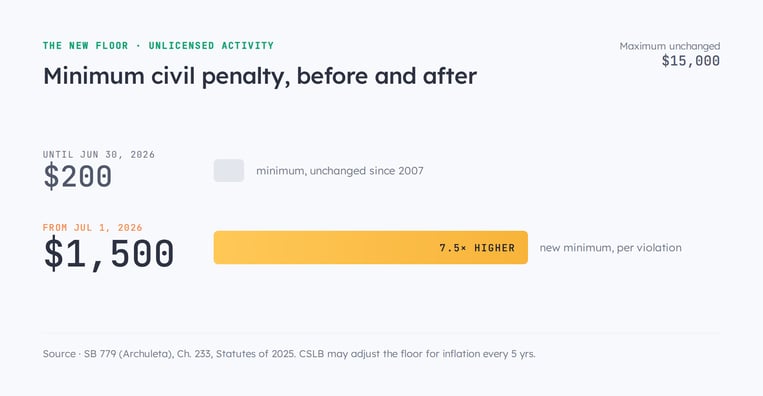
Legislative analyses flagged a gap. When penalties were appealed, administrative law judges often cut them toward the old minimum. A $1,500 floor is far harder to discount than a $200 one. The point is deterrence that holds up on appeal.
02 · THE EXPOSURE
Why this lands on Trade Partners
The crackdown targets unlicensed activity. The trap is assuming that only applies to operators who never held a license. It does not. A lapsed license counts. Work performed during any gap in good-standing licensure is unlicensed work, even if the lapse was an oversight.
That sits on top of a rule California already enforces hard. Under Business and Professions Code Section 7031, an unlicensed contractor cannot sue to collect unpaid fees, and a client can recover every dollar already paid through disgorgement. Courts apply this even when the work was done well. Add SB 779 and a lapse becomes a financial event, not a clerical one.
One more number sets the threshold. A CSLB license is required for any project where labor and materials reach $1,000 or more. Below that, and only in narrow conditions, work can proceed unlicensed. Above it, the license is the job.
03 · THE RIPPLE
What it means for the GCs who hire you
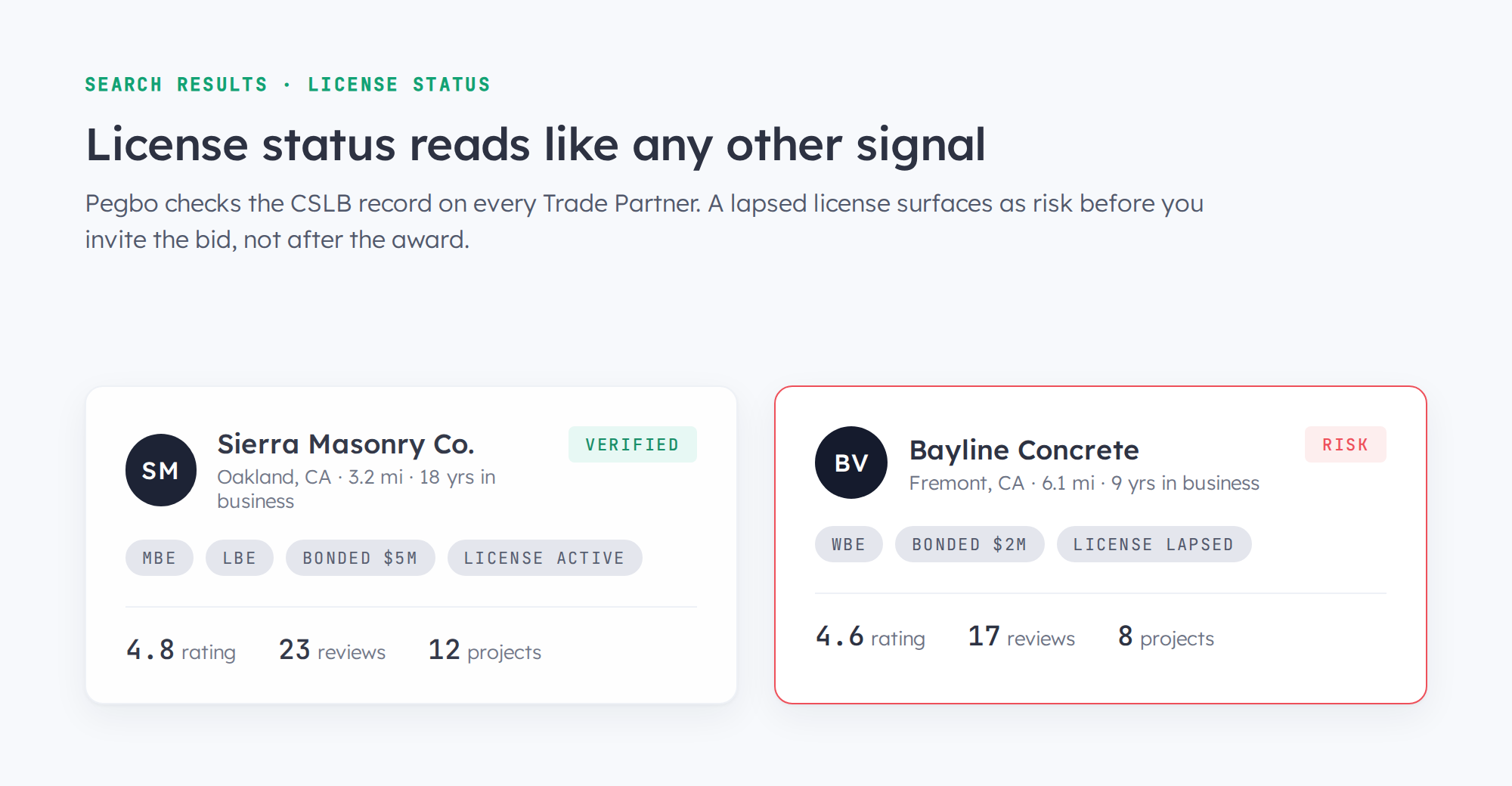
SB 779 gives General Contractors a sharper reason to verify license status early. The exposure reaches the buyer's side too. For public work, the registrar gives a public entity 72 hours of written notice and can cite the responsible officer or employee for awarding a contract to an unlicensed contractor.
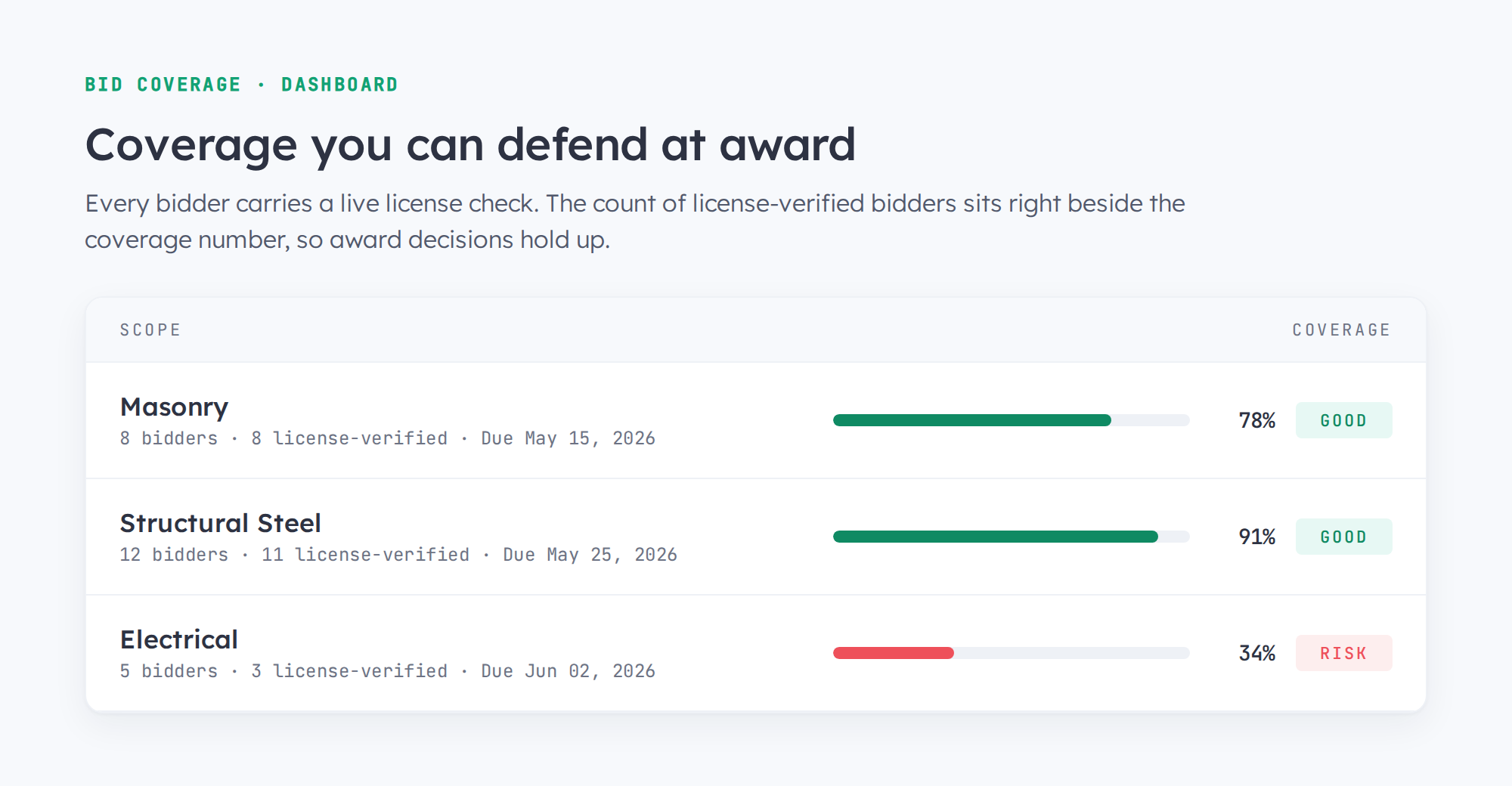
The practical effect is simple. License verification moves earlier in the bid process. The Trade Partner whose active status is easy to confirm gets invited. The one whose status takes a phone call and a wait gets passed over.
04 · THE MOVE
What to do before July 1, 2026
None of this requires a scramble. It requires keeping a few things current and making them easy to see.
- Confirm your CSLB license is active and check the renewal date so it will not lapse mid-project.
- Keep your bond and classifications current, since a coverage gap reads the same as a license gap to a GC.
- Make your status easy to verify. Sit in a network that checks the CSLB record for you, so a GC sees "active" without a phone call.
- For GCs: build the license check into prequalification, not the award. Catch a lapse before the invite, not after the contract.