
Win rates on the West Coast no longer turn on who you know. They turn on who shows up qualified, verified, and ready when coverage runs thin.
The bench replaced the Rolodex
Top general contractors used to carry the bench in their heads. A project executive knew six masonry subs, called three, and hoped two would bid. That model breaks the moment a GC runs 40 bid packages across a dozen active pursuits.
California raised the stakes. Public work carries DIR registration, prevailing wage, and Good Faith Effort goals for MBE, WBE, and DVBE participation. A GC cannot cover a school district bid with the same 8 subs it used last quarter. It needs depth on every trade. It needs proof for every Trade Partner.
So the bench moved out of the Rolodex and into a system. The question changed from “who do I know” to “who is qualified, available, and verified right now.”
What the GC sees before you pick up the phone
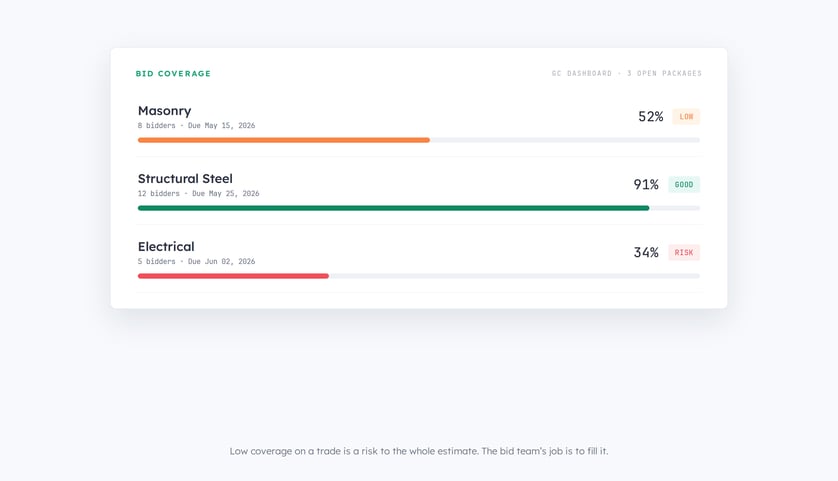
Before a project engineer invites anyone to bid, they read the coverage. Coverage is the share of a trade that has live, qualified bidders. Low coverage on Masonry threatens the whole estimate, so the bid team works to fill it.
That screen decides your invitation. Sit outside the system, incomplete or unverified, and you never enter the coverage count. You are not a low-coverage fix. You are not visible at all.
The signals that earn a seat
A bid team reads a Trade Partner profile in seconds. They scan for the same signals every time.
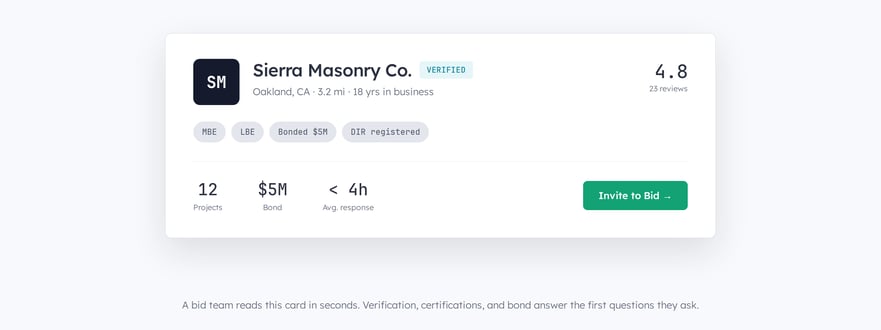
- Verified status. A confirmed license, address, and contact beats a cold lead every time.
- Certifications. MBE, WBE, DVBE, LBE, and SBE statuses map straight to a GC’s Good Faith Effort obligations on public work.
- Bonding capacity. “$5M bonded” answers the first question a GC asks on any package above a threshold.
- Track record. Years in business, completed projects, and reviews from other GCs outweigh any polished pitch.
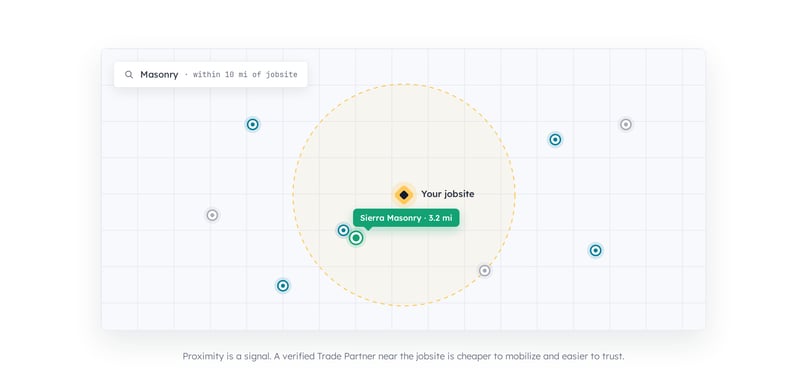
- Proximity. A Trade Partner 3.2 mi from the jobsite costs less to mobilize and earns trust faster.
What keeps you on the bench
One invitation is not the bench. The bench is the shortlist a GC returns to without thinking. Earn the return invite three ways.
- Respond fast. A bid team filling coverage against a Friday deadline remembers who answered.
- Bid complete. A clean, fully scoped proposal saves the estimator a follow-up call.
- Close the loop. Decline early when you cannot bid. A clear “no” protects the relationship better than silence.
Pegbo tracks these moments quietly, the way a good coworker keeps notes. Every on-time response and complete bid strengthens your standing the next time coverage runs low.
How to get found
Build a profile that a bid team can act on.
- Complete every field. A half-filled profile reads as a half-serious Trade Partner.
- Verify what you can. Upload the license, the bond letter, and the certifications.
- Keep coverage current. Update your trades, your service radius, and your capacity so the right packages find you.
Over 1M+ verified Trade Partners already sit in the network California’s top GCs search. The bench is being built right now. The only open question is whether your profile is ready when a bid team searches for your trade.