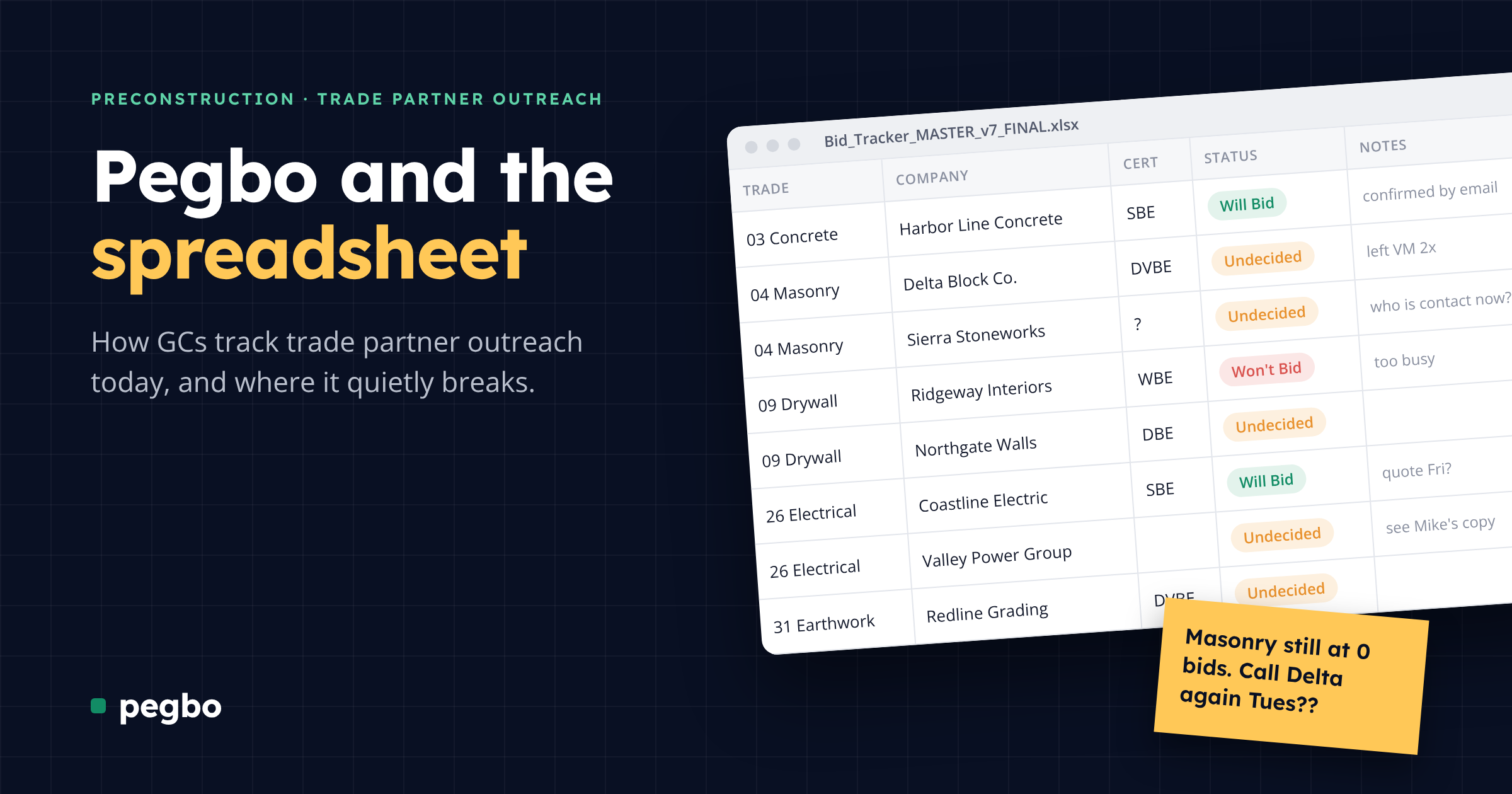

Most preconstruction teams still run trade partner outreach out of a spreadsheet. It works fine until bid day, a Good Faith Effort review, or the next project. Here is how GCs track outreach today, where the sheet quietly breaks, and what a stronger system looks like.
The spreadsheet is still the system of record
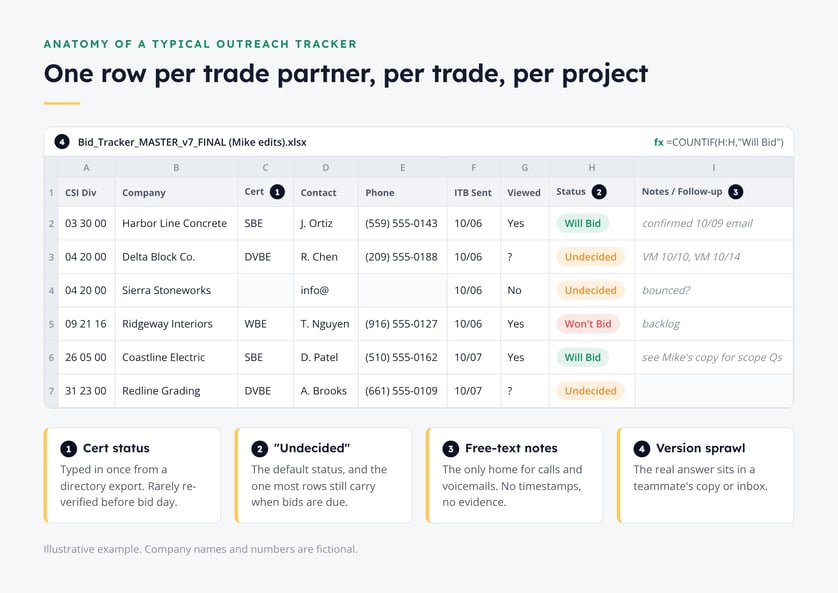
Walk into almost any preconstruction department in California and ask how the team knows which trade partners have committed to bid. Someone will open a spreadsheet. It might be called the bid tracker, the sub list, or the coverage sheet, but the shape is always the same: one row per trade partner, per trade, per project.
The workflow is so standard that GCs write it into their SOPs. One precon SOP manual published in Procore's training center lays it out step by step. Export the invited trade partners from the bid platform. Delete the trades that are not yours. Remove duplicates by email address. Paste the list into a fresh copy of the master tracker and reset every status to "Undecided." Two to three days after the ITB goes out, send a bid confirmation email per trade, then flip each row to Will Bid, Won't Bid, or Undecided as answers trickle in. Anyone who declines, and any trade without coverage, gets a phone call.
None of this means the team is behind the times. Bid management software is now common. In BuiltWorlds' latest Preconstruction Benchmarking Report, 71.5% of surveyed contractors said they use bid management tools regularly. But 81% said they use them mainly to compare and level bids. The outreach itself, the calls, the voicemails, the "let me check with my PM," still tends to land in a side sheet.
Why the spreadsheet survives
Estimators are not wrong to like their trackers. The spreadsheet earns its place for real reasons.
- Everyone already knows it. No training, no license, no onboarding.
- It sits across platforms. One pursuit runs through BuildingConnected, another through an owner's portal, a third starts from an agency's certified firm directory. The spreadsheet is the only place they all meet.
- It bends to the job. Add a column for bonding, union status, or "worked with us on the library job" in ten seconds.
- The estimator owns it. No admin ticket required to change a field.
The problem is not that spreadsheets are bad. It is that trade partner outreach has outgrown what a static grid can hold.
Where the spreadsheet breaks
1. The math multiplies the rows
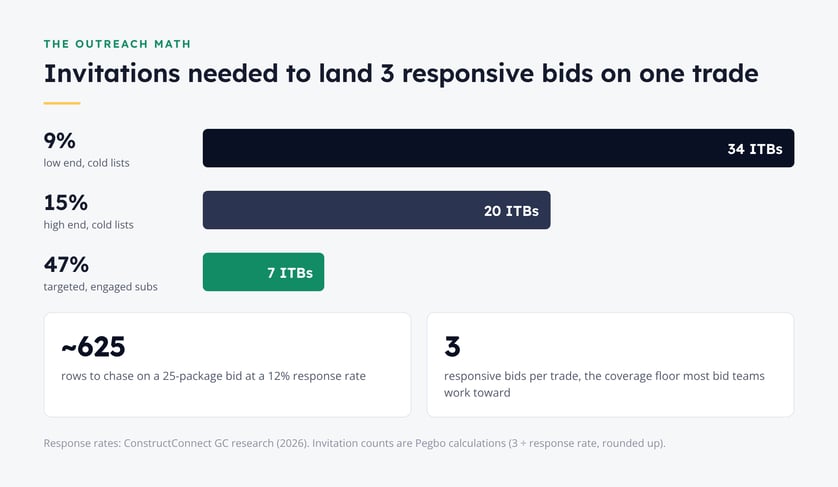
ConstructConnect's GC research puts the typical subcontractor response rate for commercial GCs at 9 to 15%, and most bid teams work toward a floor of three responsive bids per trade. Run the arithmetic and a single trade can take 20 to 34 invitations to land three numbers. Across a 25-package bid at a 12% response rate, that is roughly 625 rows, each one a potential follow-up.
The same research found response rates climb to 47% when GCs target engaged trade partners, which cuts the list to about seven invitations per trade. The difference is not effort. It is knowing who actually responds, and a blank copy of the master tracker does not carry that forward.
2. "Undecided" is not a status
Every row starts as Undecided, and on most trackers a large share of rows end that way. Silence is not data. A clear "won't bid" is worth more, because it tells the estimator to stop calling and widen the list. A spreadsheet cannot tell the difference between a trade partner who opened the ITB and passed, one who never received it because the email bounced, and one who is pricing it right now but has not said so.
3. Phone calls disappear
The most valuable outreach in precon happens on the phone in the last 48 hours before bid day. On a spreadsheet, that work becomes "VM 10/14" in a notes column, if it gets written down at all. There is no record of who made the call, nothing an agency would accept as proof, and nothing that survives when the estimator moves to the next pursuit.
4. Versions multiply
The tracker gets emailed to the PM, saved to a shared drive, and copied for the second bid package. By bid week, the real answer on electrical coverage is in someone else's copy or someone's inbox. Anyone who has opened a file named "Bid_Tracker_MASTER_v7_FINAL" knows how this goes.
5. The bench resets every project
Which trade partners respond fast, which bid complete, which always pass on prevailing wage work: that knowledge lives in the estimator's head and in last year's files. When a new pursuit starts, the team starts from a fresh export and the same cold list.
On California public work, the outreach log is the deliverable
On private work, a messy tracker costs time. On California public work, it can cost the bid.
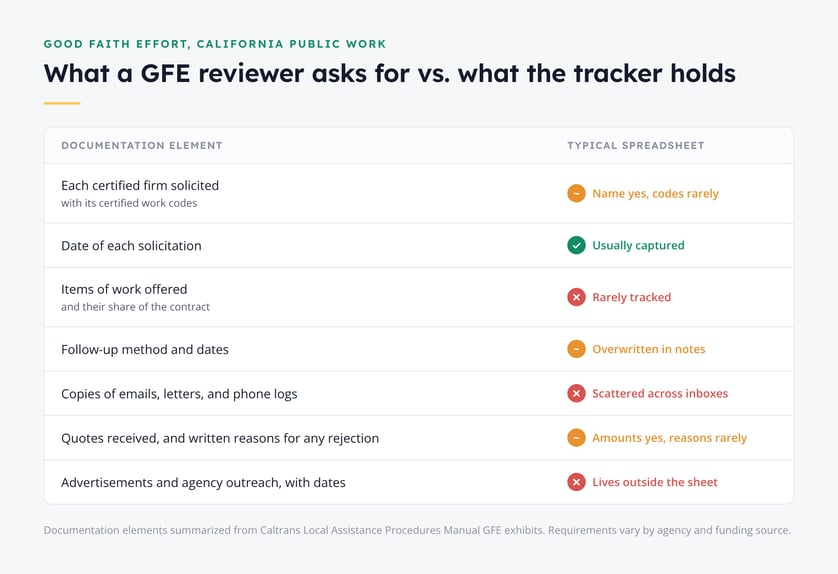
Agencies that set DBE, DVBE, or SBE participation goals expect bidders who fall short to prove a Good Faith Effort, and that proof is built from outreach records. Caltrans' Local Assistance Procedures Manual is a good example of what reviewers look for: the certified firms solicited and the work they are certified to perform, the date of each solicitation, the items of work offered, how and when the bidder followed up, the quotes received, written reasons for rejecting any of them, and copies of the letters, emails, and phone logs behind it all. That package is typically due within days of bid opening, not weeks.
California's Subletting and Subcontracting Fair Practices Act adds another layer. Public Contract Code section 4104 requires the prime to list every subcontractor whose work exceeds one-half of 1% of the total bid, along with each firm's license number and public works registration number. The listing is only as reliable as the outreach and verification behind it.
A spreadsheet can hold the rows. It rarely holds the evidence.
What good outreach tracking looks like
Whatever tool you use, the precon teams that hit coverage consistently share a few habits.
- Set a target before release. Decide how many responsive bids each trade needs before the ITB goes out. Three is a common floor. Specialty trades with only a handful of qualified local firms need their own plan.
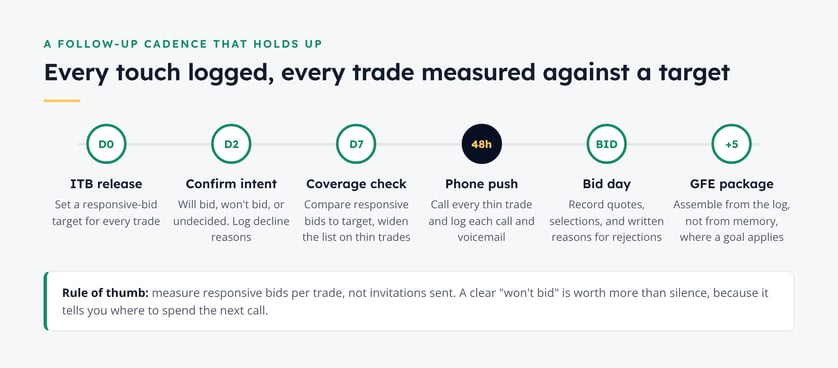
- Measure responsive bids, not invitations. ITBs sent is a vanity metric. Responsive bids per trade, per project, is the number that matters on bid day.
- Log every touch. Each email, call, voicemail, and text gets a date, a method, and a name. All of it counts toward a GFE.
- Separate "declined" from "no response." Capture the reason. "Backlog through Q2" and "we don't do prevailing wage" tell you very different things about the next project.
- Run a cadence. Confirm intent two to three days after release, check coverage a week out, and save the phone push for thin trades in the final 48 hours.
- Build the GFE file as you go. Assemble it from the log, not from memory after bids close.
- Carry history forward. A trade partner's response record should follow them to your next pursuit.
A quick self-check for your current tracker
- Can you see responsive bids per trade right now, without opening a second file?
- If an agency asked for every contact attempt with a certified firm on your last public bid, could you produce it in a day?
- Does your tracker know which trade partners responded on your last three projects?
- Could a teammate pick up your pursuit mid-week and know exactly who to call?
- Are certifications verified for this bid, or copied from the last one?
Two or more "no" answers usually means the spreadsheet is doing more work than it was built for.
Where Pegbo fits
Pegbo was built around the work that lives in the side sheet. BidFlow gives precon teams one place to source certified trade partners from a network of more than 1M verified trade partners, send ITBs, and watch coverage build by trade as responses come in. Outreach activity is captured as it happens, so the Good Faith Effort report comes from the outreach itself instead of being rebuilt from inboxes. BidFlow works alongside Procore and BuildingConnected, so the bid board your team already uses stays in place.
The spreadsheet does not have to disappear overnight. Many teams start by running one pursuit in Pegbo next to their tracker and comparing what each one knows on bid day.
See how BidFlow tracks outreach on your next bid →
Frequently asked questions
How do general contractors track trade partner outreach today?
Most GCs pair a bid management platform for sending ITBs with a spreadsheet that tracks each trade partner's status, follow-ups, and notes by trade. The platform handles distribution. The spreadsheet handles everything that happens after, including phone calls, which is where most coverage gaps and documentation gaps appear.
How many trade partners should a GC invite per trade?
Work backward from responsive bids. Most teams target at least three per trade. With an engaged, targeted list, five or six invitations is a reasonable starting point for commodity trades. With a cold list at a 9 to 15% response rate, you may need 20 or more.